Claw Machine vs. Coin Pusher: Which Play Style Fits You?
Choose a claw machine if you prefer one focused positioning-and-drop action around a visible target. Choose a physical coin pusher if you prefer placing a token and watching movement build across a changing playfield.

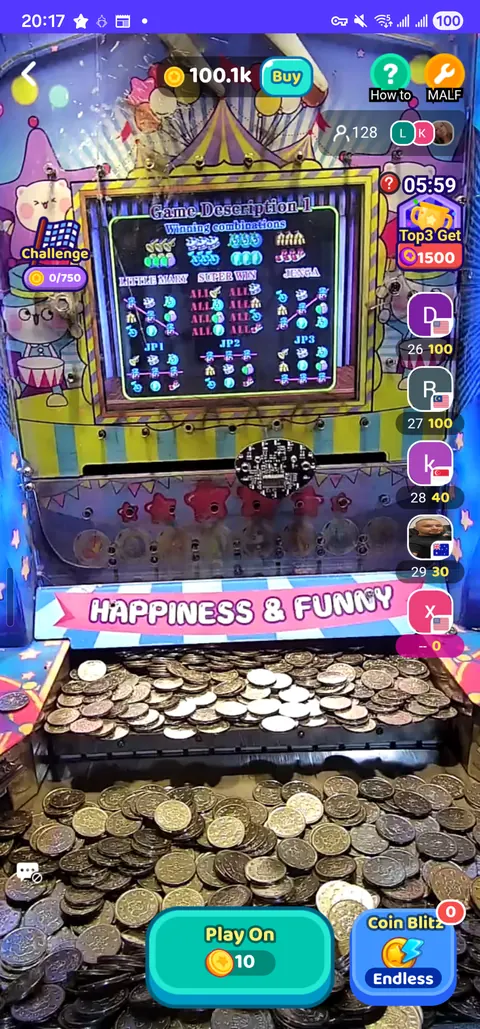
Overview
Neither format is universally easier, more profitable, or more likely to produce a result. The useful difference is the kind of input you make, the motion you watch, and how each physical play reaches its recorded result.
Quick comparison
| Real claw machine | Physical coin pusher | |
|---|---|---|
| Main player input | Position and drop the claw | Position the drop arm and release a token |
| Main thing to watch | Claw, target, travel path, and prize chute | Drop area, moving pusher, stacked playfield, and physical drops |
| Motion pattern | A distinct grab sequence | Repeating shelf movement before and after the token enters |
| Result boundary | Prize enters the prize chute and the play is recorded as successful | Result follows what the physical machine actually drops and records |
| Best fit for | Players who enjoy one targeted mechanical action | Players who enjoy watching how one token affects a changing playfield |
Choose a claw machine for a focused target
A real claw-machine play centers on one visible target and one mechanical sequence. You use the available controls to position the claw, then drop it. The machine descends, closes, lifts, travels, and releases while you watch the physical cabinet through live video.
This style may suit you if you like making a compact positioning decision and following one attempt from start to finish. The target and the claw are visually distinct, so the action has a clear focal point.
The result boundary is also specific: touching, lifting, or briefly holding a prize is not enough. The prize must enter the prize chute and the play must be recorded as successful.
Choose a physical coin pusher for a changing field
A physical coin-pusher play centers on a moving playfield rather than one grab. You position the drop arm and release a token. The machine’s pusher continues its mechanical cycle, transferring movement through the physical layers.
This style may suit you if you enjoy watching how one input joins an existing field and how the field changes over time. The movement is distributed: a token can affect nearby layers without letting you directly control every object.
The result follows what the real machine actually drops and what is recorded for the play. This page does not convert the visible field into a probability or expected return.
The biggest difference is the control loop
In a claw machine, the player’s input directly positions the grabbing mechanism before a distinct drop sequence. In a physical coin pusher, the player chooses where to release a token into a machine whose shelf is already moving.
That creates two different rhythms:
- Claw machine: position → drop → watch one complete claw sequence → check the result.
- Physical coin pusher: position the drop arm → release a token → watch the physical pusher movement → check the result.
These are descriptions, not strategies. They do not establish a best position, a winning time, or a fixed number of attempts.
What each game asks you to observe
In a claw-machine view
The key visible elements are the claw, the target area, the cabinet boundaries, and the prize chute. Camera angle can affect how alignment and depth appear, so the current live view matters more than an old screenshot.
In a physical coin-pusher view
The key visible elements are the drop area, moving shelf, stacked playfield, front edge, and side areas. The field can change after each physical input, so a previous image is not a fixed representation of the next play.
Observation helps you understand what is visible. It does not establish a probability or guarantee an outcome in either game.
Which play style should a beginner try first?
There is no universal answer. Start with the interaction that is easier for you to understand:
- Try a claw machine if you want one target and one clearly bounded action sequence.
- Try a physical coin pusher if you want to follow continuous mechanical movement across a field.
- Read the current controls, cost, and instructions before either game.
- Stop and check the recorded state if video or controls become unclear.
Do not choose based on a claim that one format is “easier to win.” Claw Eden does not publish that comparison here, and the two result types are not directly interchangeable.
What this comparison does not rank
This page does not compare win rates, RTP, prize value, difficulty, entertainment value, current prices, or room availability. It also does not promise that one game consumes fewer inputs or produces faster results.
Those claims would require current, comparable definitions and evidence. The purpose here is narrower: help a new player choose between two physical interaction styles.
Compare the two Claw Eden game pages
- [Explore real claw machines](/games/real-claw-machines/)
- [Explore physical coin pushers](/games/real-coin-pusher/)
- [Learn how remote physical arcade machines work](/guides/how-remote-arcade-machines-work/)
- [Review fair play and result checks](/fair-play/)
Frequently asked questions
Is a claw machine easier than a coin pusher?
This guide does not rank difficulty or probability. The two games use different controls and result boundaries, so “easier” is not a supported universal conclusion.
Which game gives me more control?
They offer different control, not a simple more-or-less scale. A claw machine lets you position and drop the claw; a physical coin pusher lets you position the drop arm and release a token into a moving field.
Which game is faster?
The visible rhythms differ, but this page does not promise a fixed duration. Current game flow and connection conditions can vary.
Are both examples real machines?
Yes. This comparison is limited to Claw Eden’s real claw-machine and physical coin-pusher formats.
Should I use the same guide for both?
No. Each format has different controls, visible motion, and recorded-result boundaries. Use the corresponding game guide for details.