Coin Pusher, Penny Falls, or Medal Game? The Terms Explained
“Coin pusher” is the broad English description for a machine where coins or tokens are added to a moving playfield. “Penny falls” is a familiar British name for a related machine format. “Medal game” is a broader Japanese arcade category, and only some medal games are pushers.
Overview
The words overlap, but they do not always describe the same machine, currency, or result system. This guide separates the terms without making legal, payout, or probability claims.
Quick comparison
| Term | Best understood as | Important limit |
|---|---|---|
| Coin pusher | A general machine type with a moving pusher and coin/token playfield | Does not specify cash, prizes, tickets, credits, or current rules |
| Penny falls | A British name used for coin-pusher machines, traditionally associated with pennies | Regional wording; do not assume every modern machine uses pennies |
| Medal game | A broad Japanese arcade category using arcade medals | Not every medal game is a pusher |
| Medal pusher | A pusher-format game within the medal-game category | More precise than calling every medal game a coin pusher |
| Physical coin pusher | A real cabinet with a mechanical playfield | Must be supported by the actual product scope, not visual style alone |
What does “coin pusher” mean?
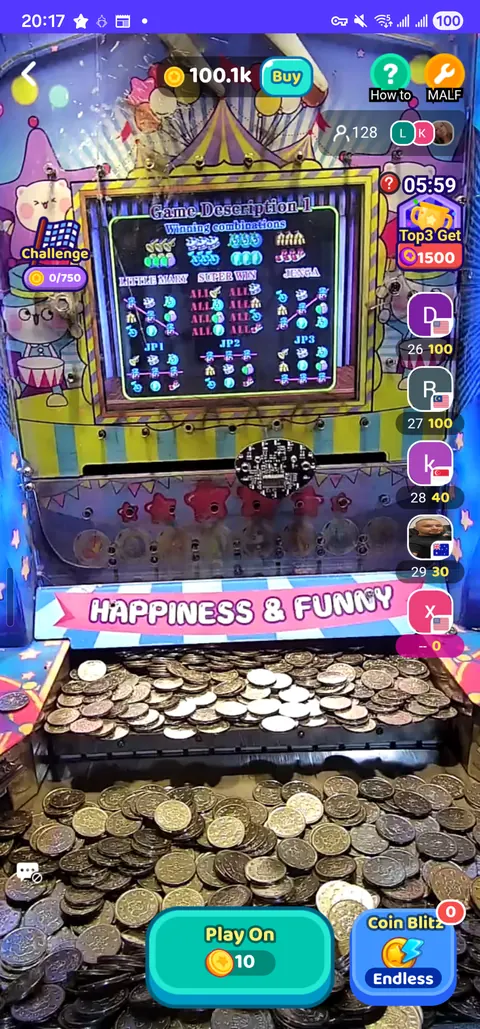
“Coin pusher” describes the visible mechanical idea: a player adds a coin or token to a playfield while a pusher shelf moves repeatedly. Objects may shift across the physical layers as the machine cycles.
The term does not say what the inserted object is worth, what can be received, whether anything is redeemable, or how a particular operator records results. Those are separate product and local-rule questions.
Claw Eden uses physical coin pusher for its real-machine format. In that format, live video shows the physical playfield, the player positions the drop arm and releases a token, and the machine completes the physical movement.
What does “penny falls” mean?
“Penny falls” is a British term for this machine type. The UK Gambling Commission uses “coin pushers” and “penny falls” as names for the same general machine type in its Category D guidance.
The name reflects a familiar coin-based version of the machine. It should not be treated as proof that every pusher uses British pennies today. The name alone does not tell you whether the physical field uses coins, tokens, or medals, or whether play is purchased through cash, credits, or another operator-specific system.
What is a medal game?
In Japanese arcades, medal game is a broad category built around arcade medals. Official SEGA and KONAMI catalogs include medal titles with different formats, including products specifically labeled as medal pushers.
That distinction matters: a medal pusher is a type of medal game, but a medal game is not automatically a pusher. The broader category can include other mechanical or screen-based formats.
Use medal pusher when a Japanese machine or official product source identifies the pusher format. Use medal game when discussing the larger category.
Are coins, pennies, tokens, and medals interchangeable?
Not exactly. They can play a similar physical role on a pusher field, but the words carry different contexts:
- coin is the broadest everyday English word in the machine name;
- penny points to a particular regional and historical arcade tradition;
- token is a neutral word for an operator-issued playing piece;
- medal is the established term in Japanese arcade medal-game systems.
The word used in an article should match the machine being described. It should not imply cash value, exchangeability, or a legal classification without a current authoritative source.
Does the name reveal how rewards work?
No. A term such as coin pusher or penny falls does not establish:
- whether the physical field uses coins, tokens, or medals;
- whether play is purchased through cash, credits, or another operator-specific system;
- whether fallen objects become points, tickets, prizes, credits, or something else;
- the price of an input;
- the probability or expected return;
- the legal category in the player’s location;
- whether a particular machine is currently available.
Those facts must come from the current game, operator rules, and applicable local information. A terminology page cannot substitute for them.
Which term does Claw Eden use?
Claw Eden uses coin pusher as the main English category term and physical coin pusher when describing its real, remotely controlled cabinet format.
For player-facing Claw Eden pages, “penny falls” can be mentioned as a regional search synonym, while “medal game” should be explained as a broader Japanese category rather than used as a direct replacement.
Frequently asked questions
Are coin pushers and penny falls the same?
They can describe the same general machine type, especially in the United Kingdom. “Coin pusher” is the broader international term; “penny falls” is more regional.
Is every medal game a coin pusher?
No. Medal game is a broader Japanese arcade category. Medal pushers are one part of that category.
Does a coin pusher have to use real money?
No. The name alone does not tell you whether the physical field uses coins, tokens, or medals, or whether play is purchased through cash, credits, or another operator-specific system.
What term should I use for Claw Eden?
Use “physical coin pusher” when referring to the real-machine format described by Claw Eden. Use “coin pusher” for the broad category.